Mechanical design engineer
.png)

The mechanical design engineer is involved in almost all phases of an industrial product's life cycle, from specifications to prototype validation. It's a broad scope, with varied sectors, and a title that covers very different realities depending on the context. Let's explore this profession together.
What is a mechanical design engineer?
A mechanical design engineer designs, sizes, and validates mechanical parts, equipment, or systems intended for industrial manufacturing. They translate a functional need into a feasible technical solution, taking into account material, process, cost, and safety constraints.
Their scope extends from the specifications to prototype validation and sometimes even to production monitoring. Depending on the sector and company size, they may join a technical team within a design office or lead a design project independently.
This profile is found under several titles: design and engineering engineer, mechanical designer, or mechanical R&D engineer for those focused on research and development.
What does a mechanical design engineer do? What are their day-to-day tasks?
The tasks vary depending on the company, industry sector, type of products developed, and the maturity of the projects handled. However, certain activities are consistently present, regardless of the context.
Needs analysis and specification writing
Every design project begins with an analysis phase. In collaboration with internal clients, they clarify the need, participate in drafting the specifications, all while identifying functional constraints, regulatory requirements, and limitations imposed by available manufacturing processes. This upstream work dictates the entire design.
CAD Modeling and Design
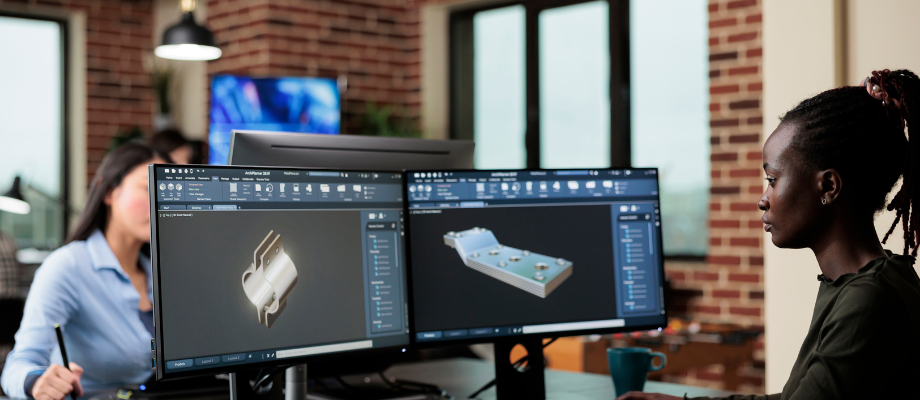
CAD modeling constitutes a significant part of the work. The tool varies depending on the sector and company, with SolidWorks, CATIA, NX, or Creo being the most common. The engineer designs parts and systems, producing plans and bills of materials usable by manufacturing teams.
Calculation and Simulation
Before manufacturing a prototype, the engineer validates their choices through calculations. Material resistance, finite element analysis, thermal or dynamic simulation: these technical studies allow for anticipating failures and optimizing the performance of mechanical products without systematically going through the physical phase.
Prototype Monitoring and Validation
Once the prototype is manufactured, the engineer participates in testing campaigns, analyzes discrepancies between actual behavior and predictions, and adjusts the design accordingly. It's often in this back-and-forth between the digital and physical realms that the profession truly becomes interesting.
In which sectors do they work?
Mechanics spans almost all industrial sectors. Automotive and aerospace remain the two largest providers of mechanical design positions in France, driven by major contractors and extensive subcontractor networks. Defense, energy, rail, and medical sectors also recruit design profiles, often for projects with high regulatory and safety requirements.
The organizations employing these engineers are varied: large industrial groups with their internal design offices, specialized SMEs, engineering firms, or ESNs (digital services companies) like the IT Link Group, which provides services to industrial clients in several of these sectors. Mechanical design Linkers work on both new product development projects and modernization phases of existing equipment.
What skills are required?
CAD software proficiency is the most visible technical skill on a CV, but it's not enough to make a good mechanical design engineer.
Technical Skills
Knowledge of materials, their mechanical properties, and their behavior according to manufacturing processes is essential. An engineer who designs without understanding how a part will be machined, molded, or welded inevitably produces plans that cause production problems. Proficiency in structural analysis and numerical simulation tools (finite elements in particular) is expected for most positions. Reading and drafting technical drawings, as well as managing tolerances and fits, are also part of the basic skillset. Finally, technical English proficiency is increasingly in demand, especially in international project contexts or for reading manufacturer documentation.
Soft Skills
Because they work on projects involving multiple teams, mechanical design engineers must be rigorous and methodical: their plans must be directly usable by manufacturing teams. Good organizational skills are also expected, as priorities can evolve throughout a project. Finally, being able to explain a technical choice to a stakeholder from another field is part of the daily routine, whether it's with quality teams, production, or the client.
What education is needed to become a mechanical design engineer?
A five-year post-secondary degree is now the norm: an engineering school specializing in mechanical engineering, industrial engineering, or structural mechanics, or a university master's degree in mechanics or systems design.
Specialization then comes with experience. An engineer who has spent several years on automotive projects does not have the same instincts as someone from the medical or energy sectors. This sectoral diversity is rarely a disadvantage.

What is the salary of a mechanical design engineer?
As with any profession, many factors come into play (responsibilities, sector, scope, company size, location, unique skills, etc.). To give you an idea of compensation, here are salary ranges from Apec based on the following parameters: Mechanical Design Engineer (M/F), Master's degree (engineering school), consulting firm with 599 to 1,000 employees, Île-de-France in 2026.
- Junior (< 4 years of experience): €36.3 to €48.1k gross/year
- Mid-level (5-8 years): €41.2 to €52.9k gross/year
- Senior (9-16 years): €45.7 to €58.8k gross/year
For a more precise estimate, tailored to your profile and our projects, we invite you to consult our job offers.
Is the mechanical design engineer profession still in demand?
The energy transition, the electrification of transport, and reindustrialization projects maintain a demand for mechanical engineering in several sectors. Automotive, aerospace, and renewable energies are among those that regularly publish job openings for these profiles, both in France and internationally. [SEG 20] The mechanical design engineer profession is for you if...
You're comfortable navigating between calculations and real-world application. You understand why a plan needs to be legible to someone who didn't draw it, and you know that design doesn't end when the CAD file is sent. If this sounds like you, then a career as a mechanical design engineer deserves your attention!

Unsolicited application
Are there currently no offers that match your profile? Share your spontaneous application with us!